
Standardization of Datasets
Data standardization is a crucial for machine learning algorithms. For instance, let us think the two features have different scales or units:
- Range of Feature A: 0 - 25
- Range of Feature B: 500 - 25000
The feature B will most likely dominate the model with the large ranges.
The data standardization rescale the data to ensure the that features contribute proportionately.
In scikit-learn, sklearn.preprocessing module provides various scalers.
from sklearn.preprocessing import (
    StandardScaler,
    MinMaxScaler,
    MaxAbsScaler,
    RobustScaler,
    PowerTransformer,
    QuantileTransformer,
    )
Linear scalers
StandardScaler: StandardScaler()
StandardScaler scales a features by removing the mean and scaling to unit variance.
\[X_{std} = \frac{X - \overline{X}} {\sigma}\]where $ \overline{X} $ is the mean of the feature and $\sigma$ is the standard deviation.
from sklearn.preprocessing import StandardScaler

X = np.array([[4, -4, -9],
              [2, -1,  0],
              [4,  2,  2],
              [2,  5,  3]])

StandardScaler().fit_transform(X)
[[ 1.         -1.34164079 -1.68654809]
 [-1.         -0.4472136   0.21081851]
 [ 1.          0.4472136   0.63245553]
 [-1.          1.34164079  0.84327404]]
- Sensitive to outliers: It uses the mean and standard deviation to center and scale the data.
- Assumes normal distribution: It works best when the data is normally distributed.
- Can be influenced by outliers: Outliers can significantly affect the mean and standard deviation, leading to suboptimal scaling.
MinMaxScaler: MinMaxScaler()
MinMaxScaler rescales a feature to a specific range, typically between 0 and 1.
\[X_{std} = \frac{X - min(X)} {max(X) - min(X)}\]from sklearn.preprocessing import MinMaxScaler
X = np.array([[4, -4, -9],
[2, -1, 0],
[4, 2, 2],
[2, 5, 3]])
MinMaxScaler().fit_transform(X)
[[1.         0.         0.        ]
 [0.         0.33333333 0.75      ]
 [1.         0.66666667 0.91666667]
 [0.         1.         1.        ]]
- Preserves original distribution: MinMaxScaler doesn’t change the shape of the original distribution.
- Sensitive to outliers: Outliers can significantly affect the scaling, as they can influence the minimum and maximum values.
- Suitable for neural networks: It’s often used in neural networks where inputs are expected to be in a specific range.
MaxAbsScaler: MaxAbsScaler()
MaxAbsScaler rescales a feature by its maximum absolute value.
\[X_{std} = \frac{X} {max(|X|)}\]from sklearn.preprocessing import MaxAbsScaler
X = np.array([[4, -4, -9],
[2, -1, 0],
[4, 2, 2],
[2, 5, 3]])
MaxAbsScaler().fit_transform(X)
[[ 1.         -0.8        -1.        ]
 [ 0.5        -0.2         0.        ]
 [ 1.          0.4         0.22222222]
 [ 0.5         1.          0.33333333]]
- Preserves sparsity: It doesn’t shift or center the data, so it’s ideal for sparse datasets.
- Simple scaling: It’s a straightforward scaling technique that doesn’t involve complex calculations.
- Suitable for specific scenarios: It’s particularly useful when you want to scale features without affecting their zero-centered nature.
RobustScaler: RobustScaler()
RobustScaler rescales a feature by removing the median and scaling it by the interquartile range.
\[X_{std} = \frac{X - \tilde{X}} {IQR}\]where $\tilde{X}$ is the median of the feature and $IQR$ is The interquartile range (Q3 - Q1).
from sklearn.preprocessing import RobustScaler

X = np.array([[4, -4, -9],
              [2, -1,  0],
              [4,  2,  2],
              [2,  5,  3]])

RobustScaler().fit_transform(X)
[[ 0.5        -1.         -2.22222222]
 [-0.5        -0.33333333 -0.22222222]
 [ 0.5         0.33333333  0.22222222]
 [-0.5         1.          0.44444444]]
- Robust to outliers: It uses the median and interquartile range (IQR) to center and scale the data.
- Less affected by outliers: The median and IQR are less sensitive to extreme values, making it more robust to outliers.
- Suitable for non-normally distributed data: It can handle skewed distributions more effectively.
Non-linear scalers
PowerTransformer: PowerTransformer()
PowerTransformer transform a features to a more Gaussian-like distribution.
- Skewness and Kurtosis: The distribution of the features is analyzed to identify skewness and kurtosis.
- Parameter Estimation: The optimal power parameter (lambda) is estimated using maximum likelihood estimation.
- Transformation: The data is transformed using the estimated lambda.
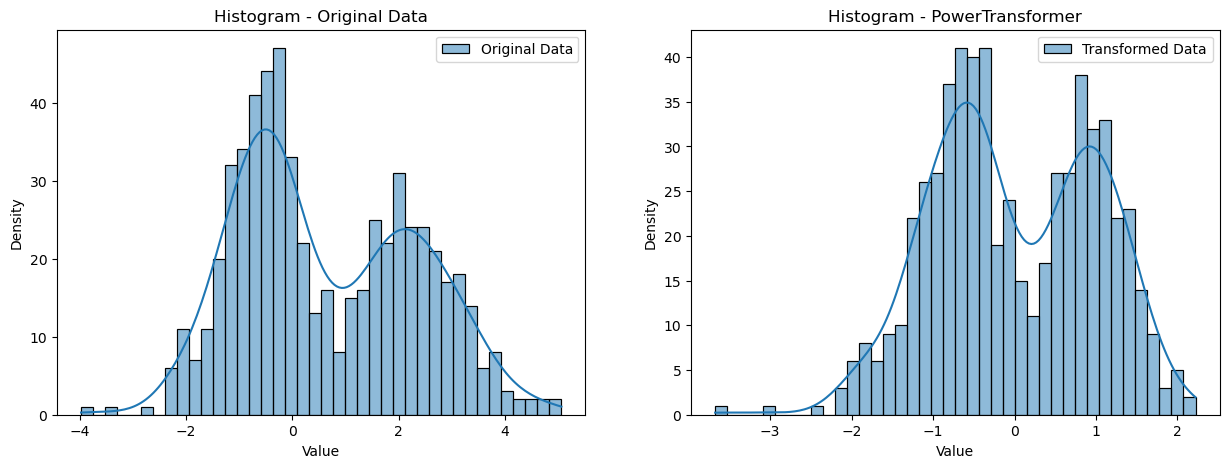
- Parametric: It assumes a specific parametric distribution (e.g., Box-Cox or Yeo-Johnson).
- Distribution-based: It transforms data to a specific distribution, often a normal distribution.
- Sensitive to Outliers: While less sensitive than some other methods, outliers can still influence the transformation.
- May Distort Rank Order: The relative order of data points might change after transformation.
QuantileTransformer: QuantileTransformer()
QuantileTransformer transform a features to a specified distribution, typically a uniform or normal distribution.
- Rank-based Transformation: Each data point is assigned a rank based on its position in the sorted list.
- Quantile Mapping: The ranks are then mapped to quantiles of the desired distribution (uniform or normal).
- Transformation: The data is transformed with their corresponding quantile map.
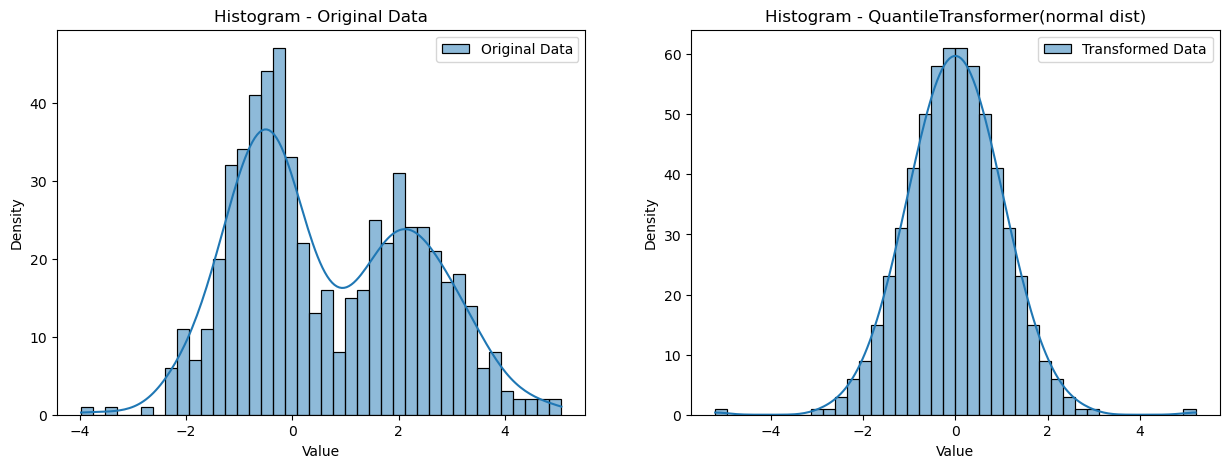
- Non-parametric: It doesn’t assume a specific distribution for the data.
- Rank-based: It maps data points to quantiles of a desired distribution (uniform or normal).
- Robust to Outliers: It’s less sensitive to outliers as it focuses on the relative ranks of data points.
- Preserves Rank Order: The relative order of data points remains unchanged after transformation.